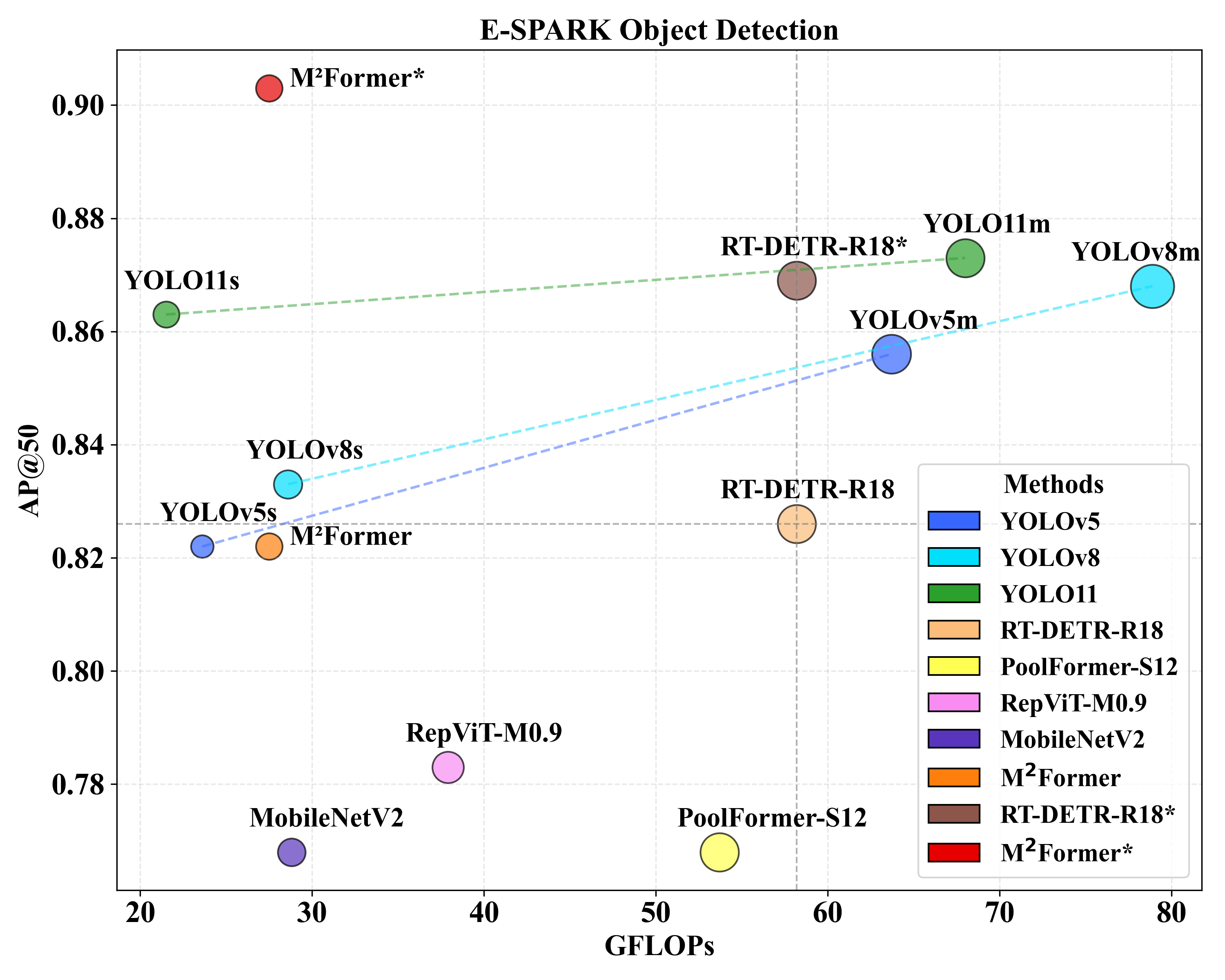
With increasing human space activities, detecting resident space objects (RSOs) has become critical for space monitoring and on-obrit missions. Traditional optical sensors struggle in space environments due to extreme illumination variations and motion blur. Event cameras, bio-inspired sensors that asynchronously record per-pixel brightness changes, offer high temporal resolution, wide dynamic range, and low power consumption, making them promising for orbital sensing yet underexplored in this context. In this work, we present the first systematic study of event-based space object detection. To address the scarcity of event data, we construct E-SPARK, a large-scale dataset generated with affine transformations and advanced simulators. Building upon this dataset, we propose M²Former, a lightweight multi-scale MetaFormer backbone, together with an area-aware loss (AAL) tailored for small object detection. These are integrated into the RT-DETR framework, a Transformer-based detector known for its robustness but higher computational cost compared to YOLO models. Our design reduces parameters and complexity by over 50% while maintaining comparable detection accuracy. In addition, we design an improved data augmentation strategy that enriches supervision density and data diversity, further boosting detection performance. Experiments on both synthetic and real event data demonstrate that our method achieves state-of-the-art performance and strong generalization. These results highlight the potential of event cameras as a reliable sensing modality for spaceborne detection.
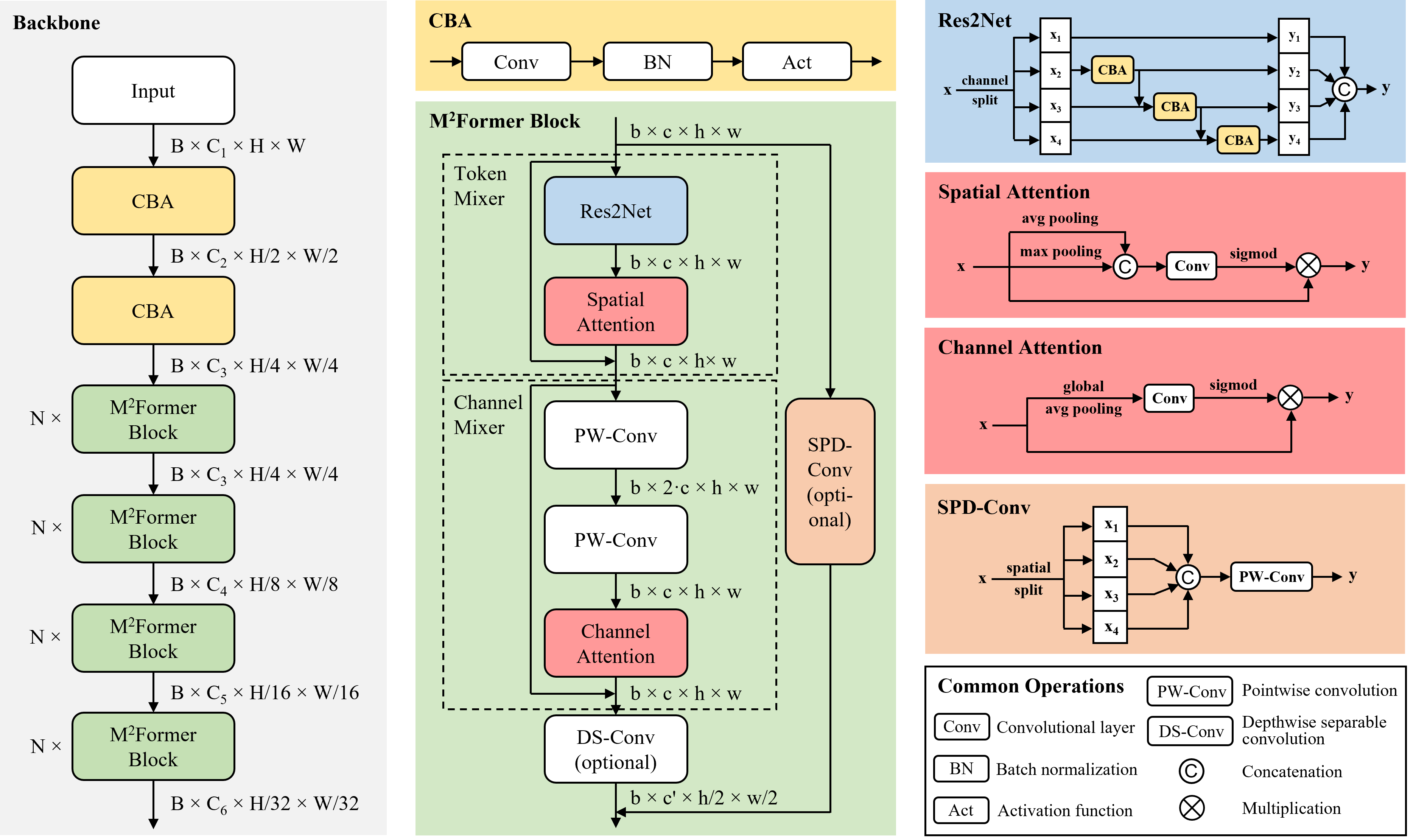
RepViT demonstrates the success of the MetaFormer paradigm within convolutional networks. Inspired by this, we redesign the RT-DETR backbone into a MetaFormer-style structure. The proposed M²Former enables efficient convolutional and downsampling operations with multi-scale feature extraction capability. It consists of Res2Net, spatial attention, channel attention, and SPD-Conv modules. Detection results on the proposed E-SPARK dataset are shown below.
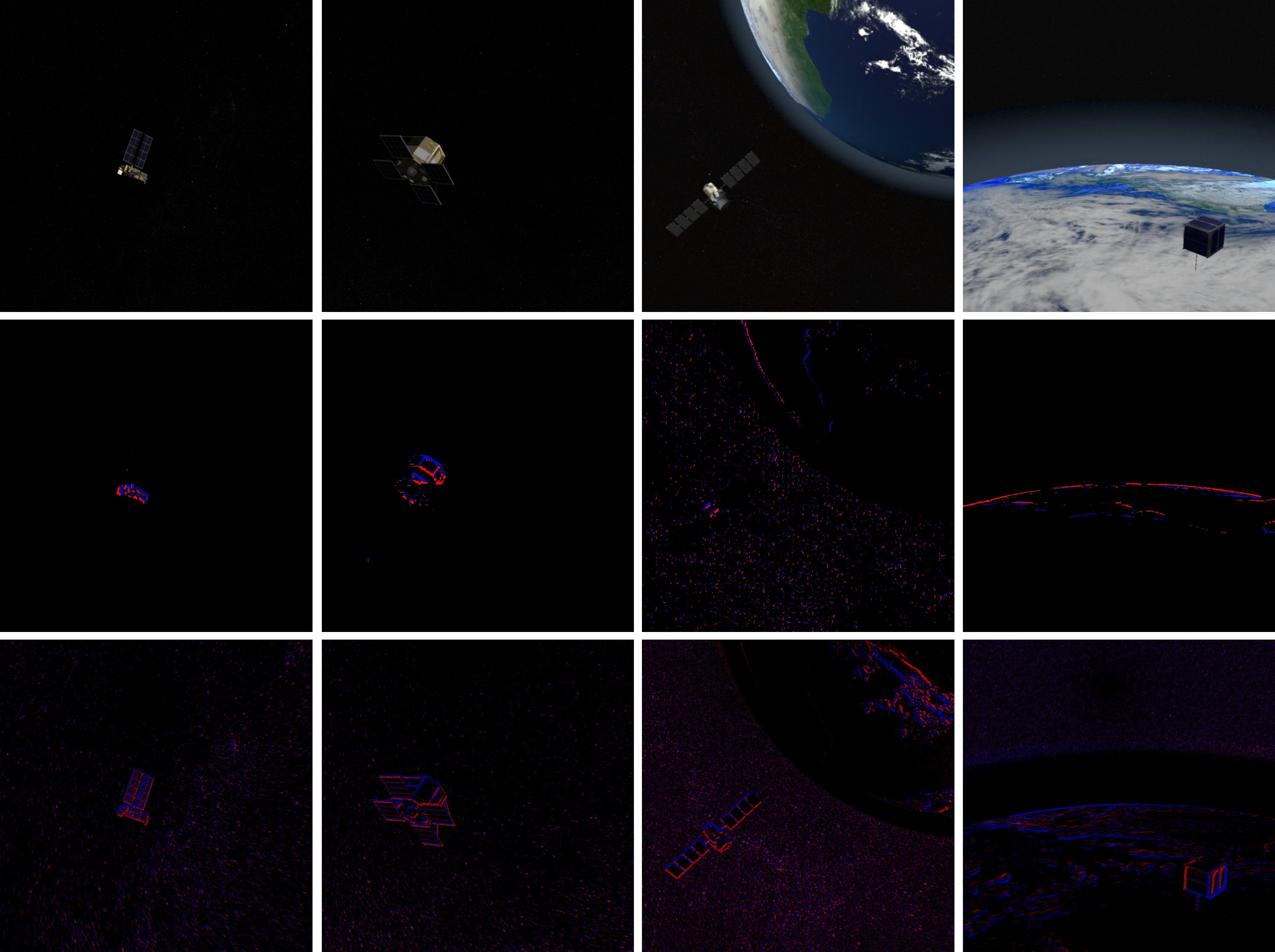
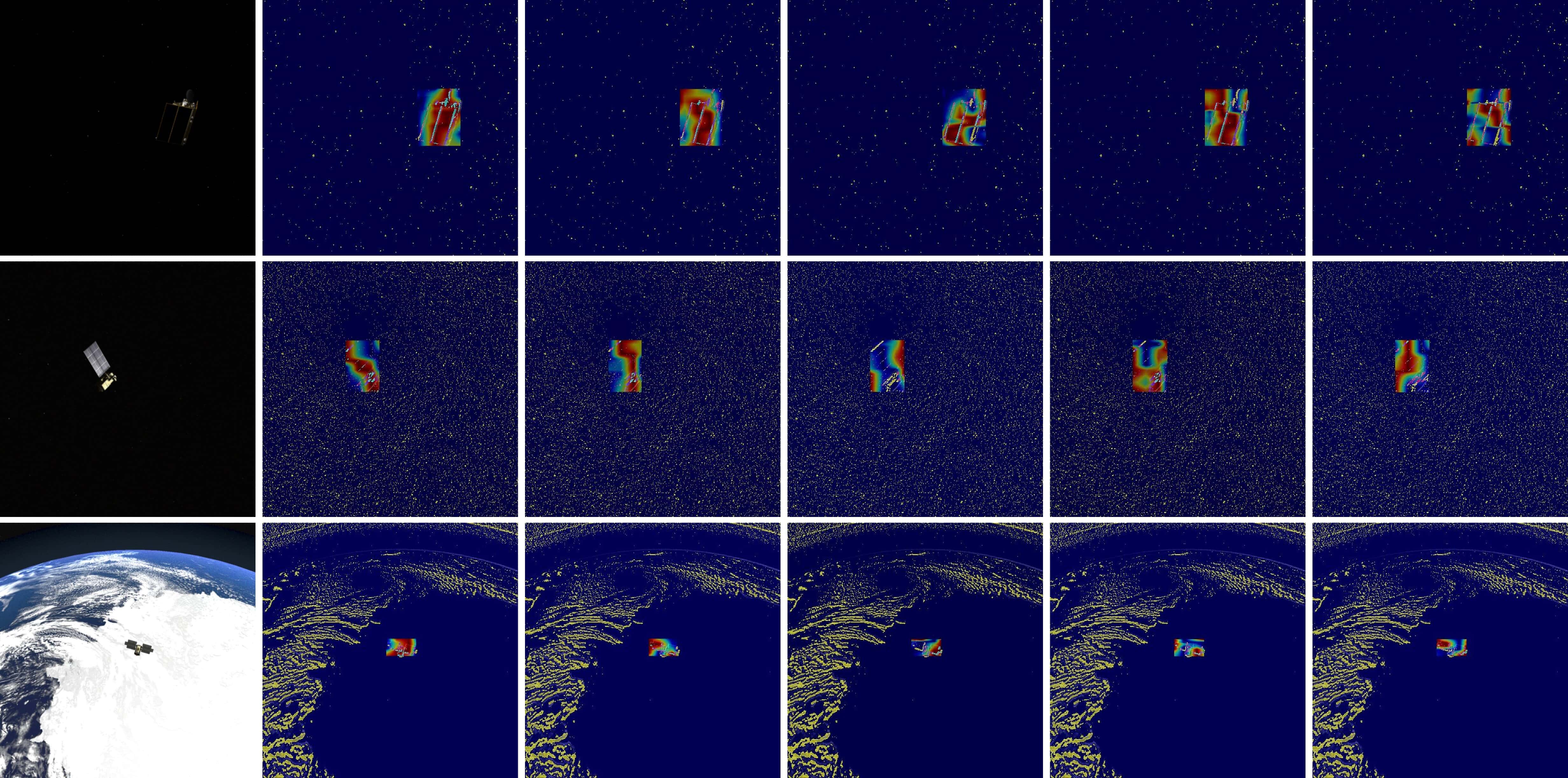
We adopt standard COCO metrics for object detection benchmarks. AP@50 represents mean Average Precision at IoU threshold 0.5, which measures overall detection accuracy. AP@50:95 averages AP over multiple IoU thresholds (0.5 to 0.95 with a step of 0.05), offering a more stringent indicator of localization precision. APs denotes average precision for small objects, highlighting performance in challenging small object detecion. In zero-shot detection, we consider it as a category-agnostic task.
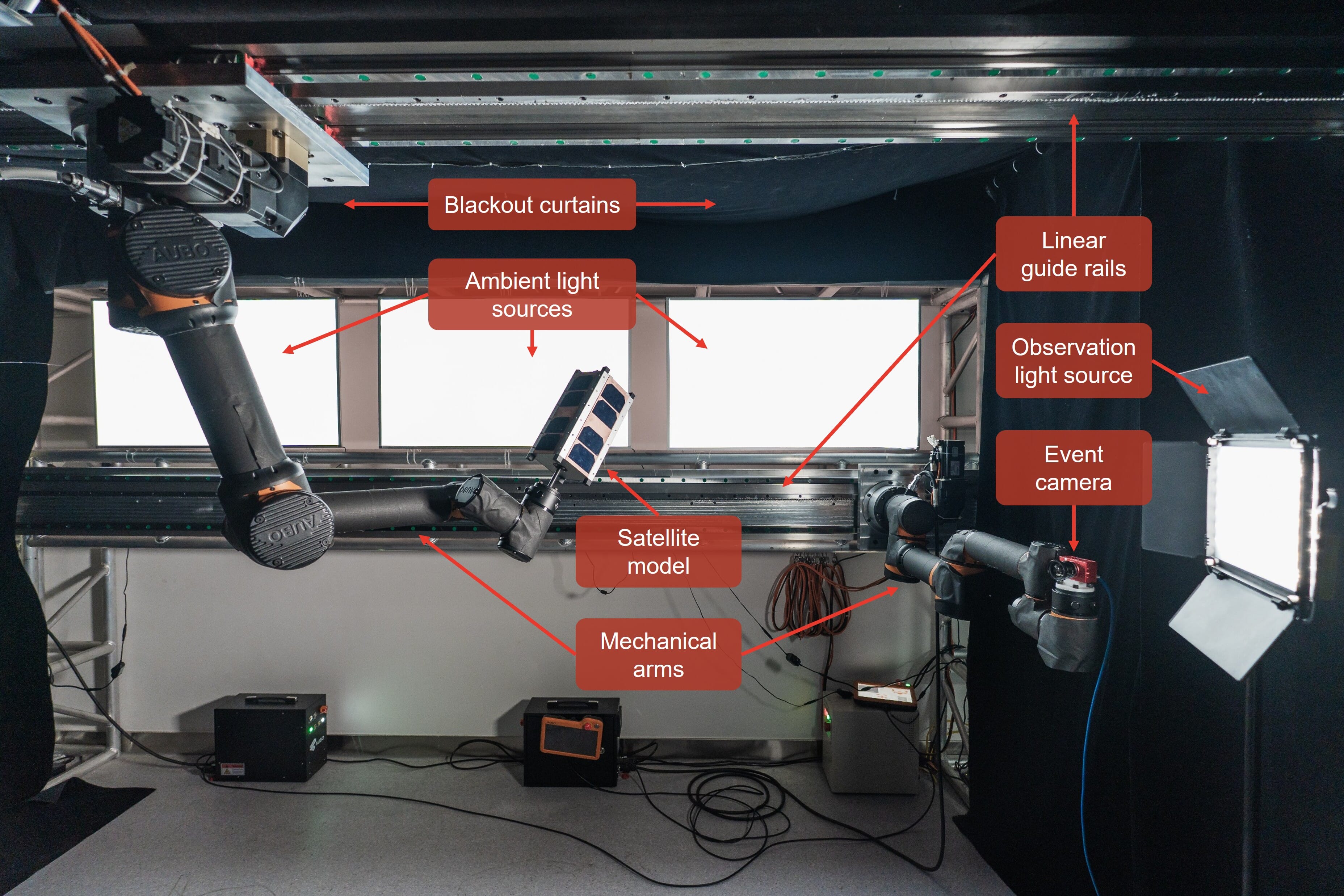
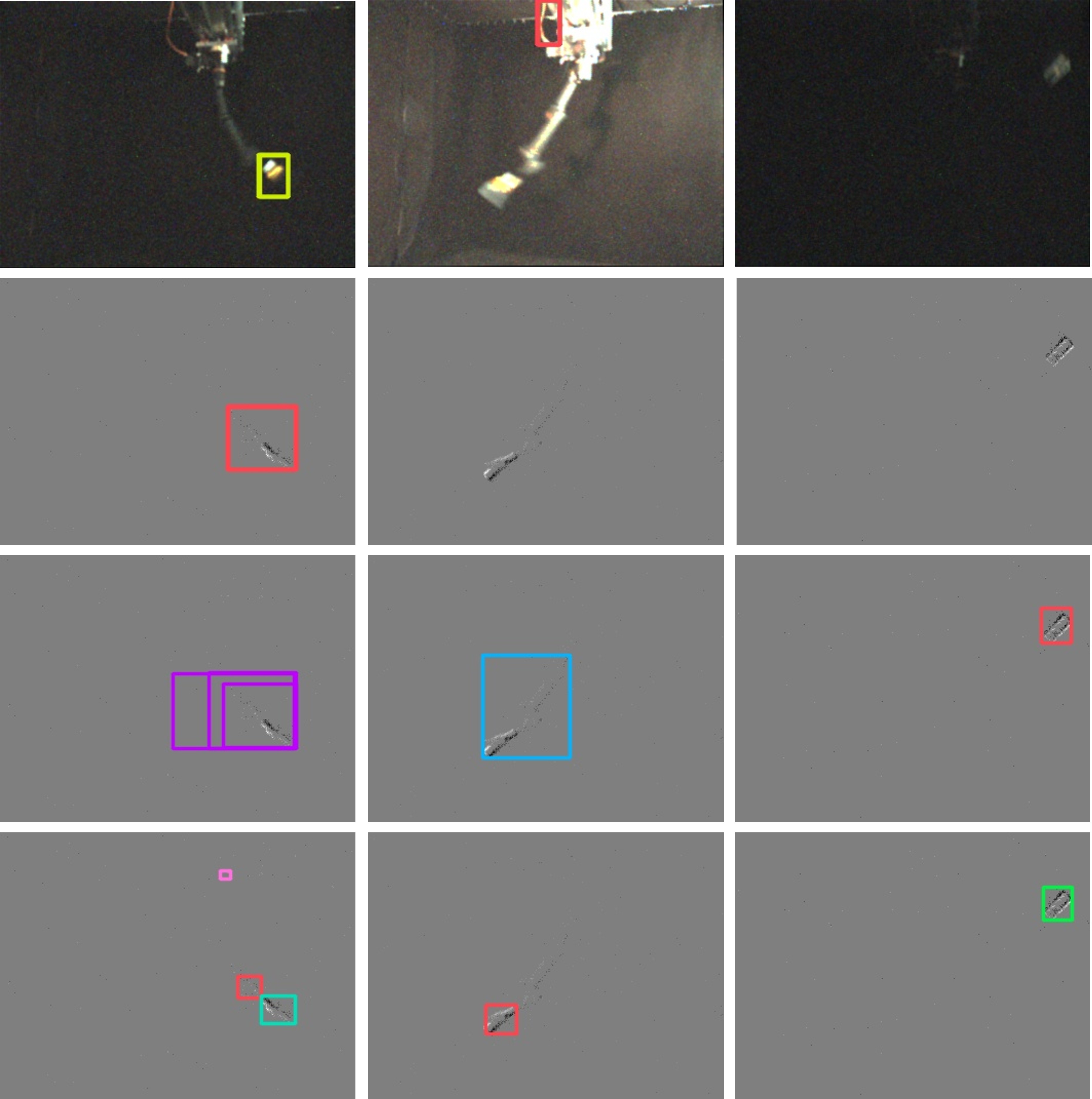
Zero-shot validation is conducted on real-world data captured from a ground-based testbed, using models trained exclusively on synthetic data without any fine-tuning. We collecte a total of 300 samples using the testbed, covering three illumination conditions:
normal exposure, overexposure, and underexposure, with 100 samples per condition. For each sample, RGB images and event data are synchronously recorded by the DAVIS346 camera at the resolution of 346×260. We adopt YOLOv8s as the representative RGB-based detector
due to its high detection accuracy and moderate model complexity.
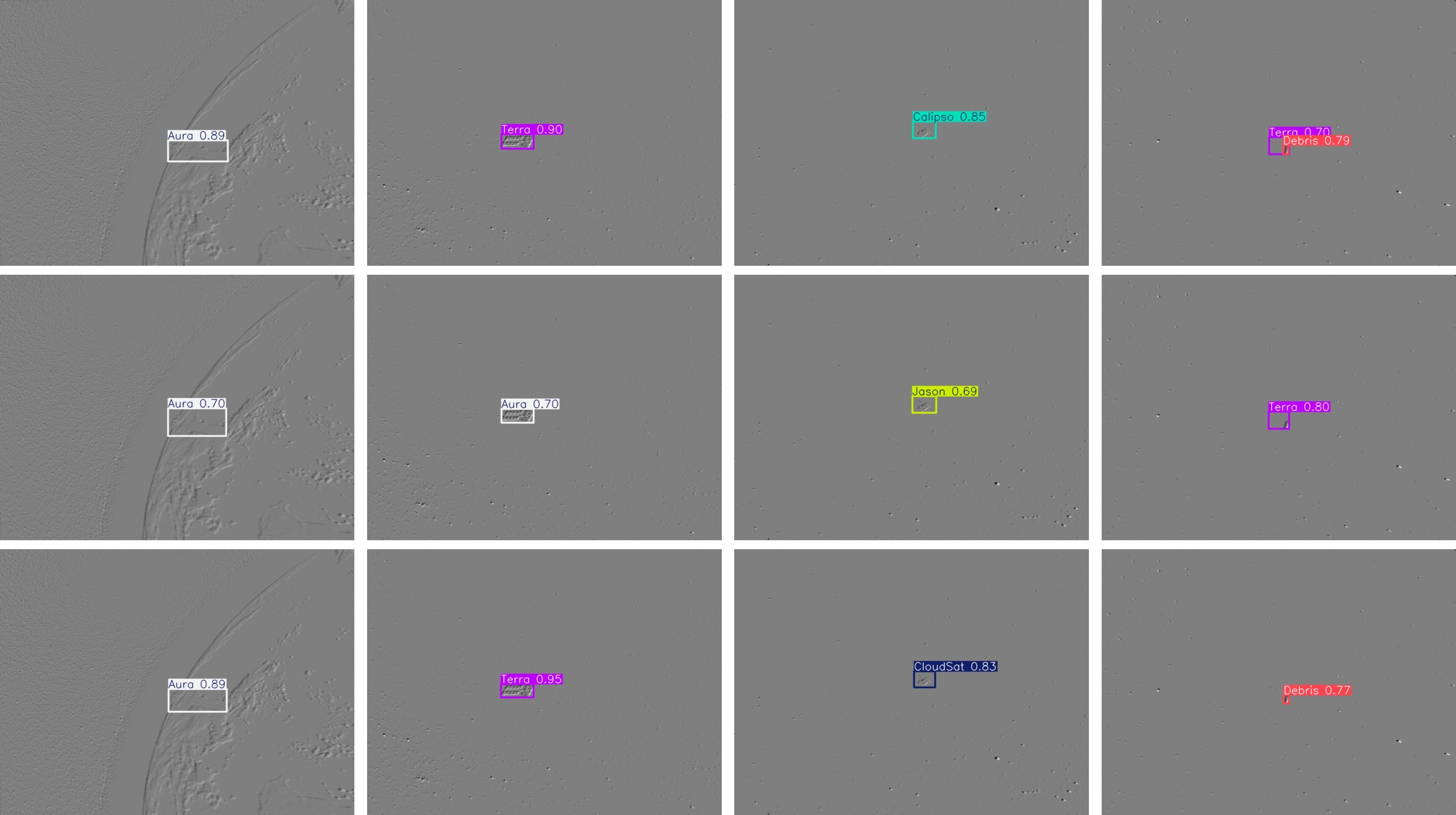
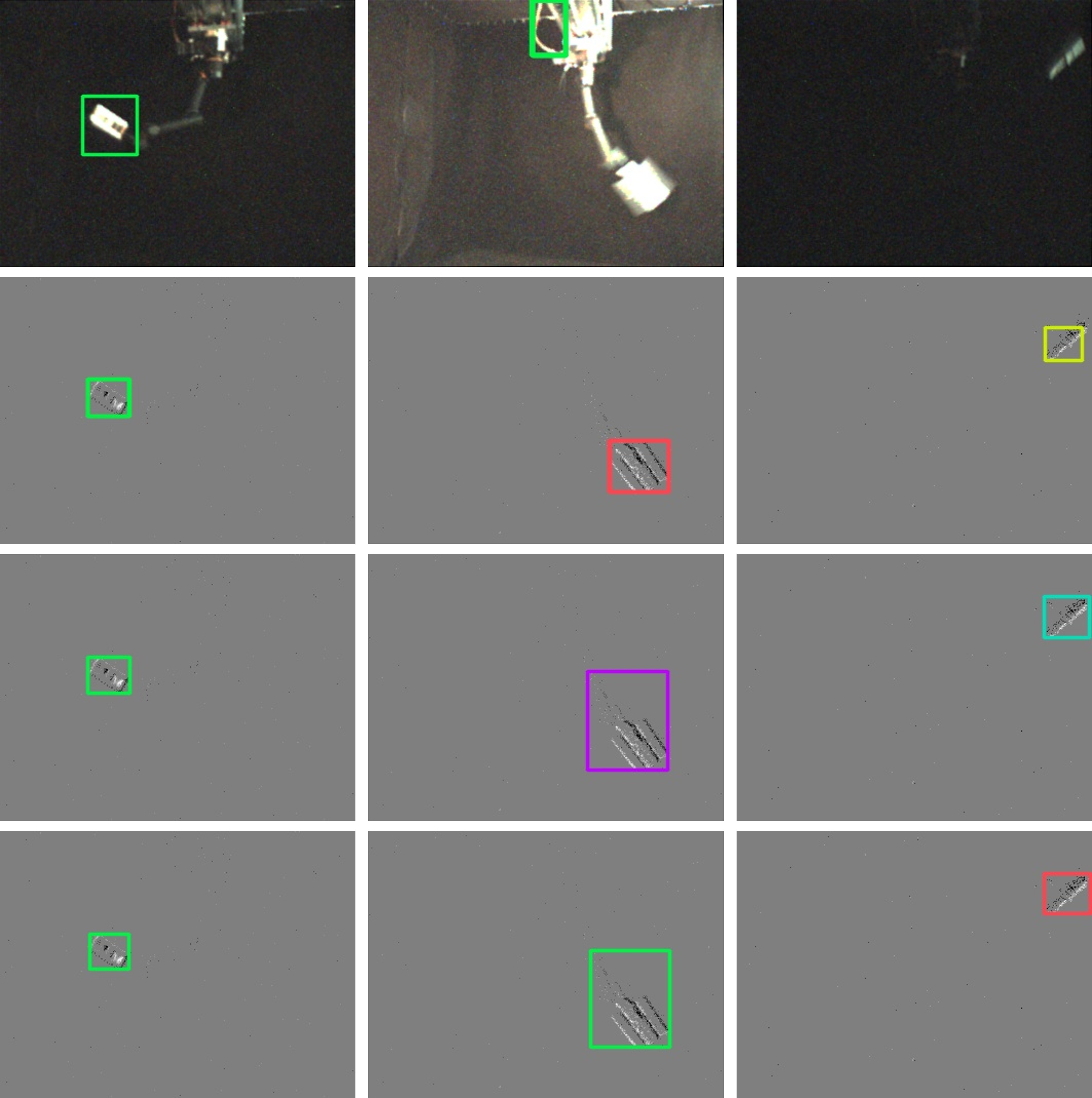
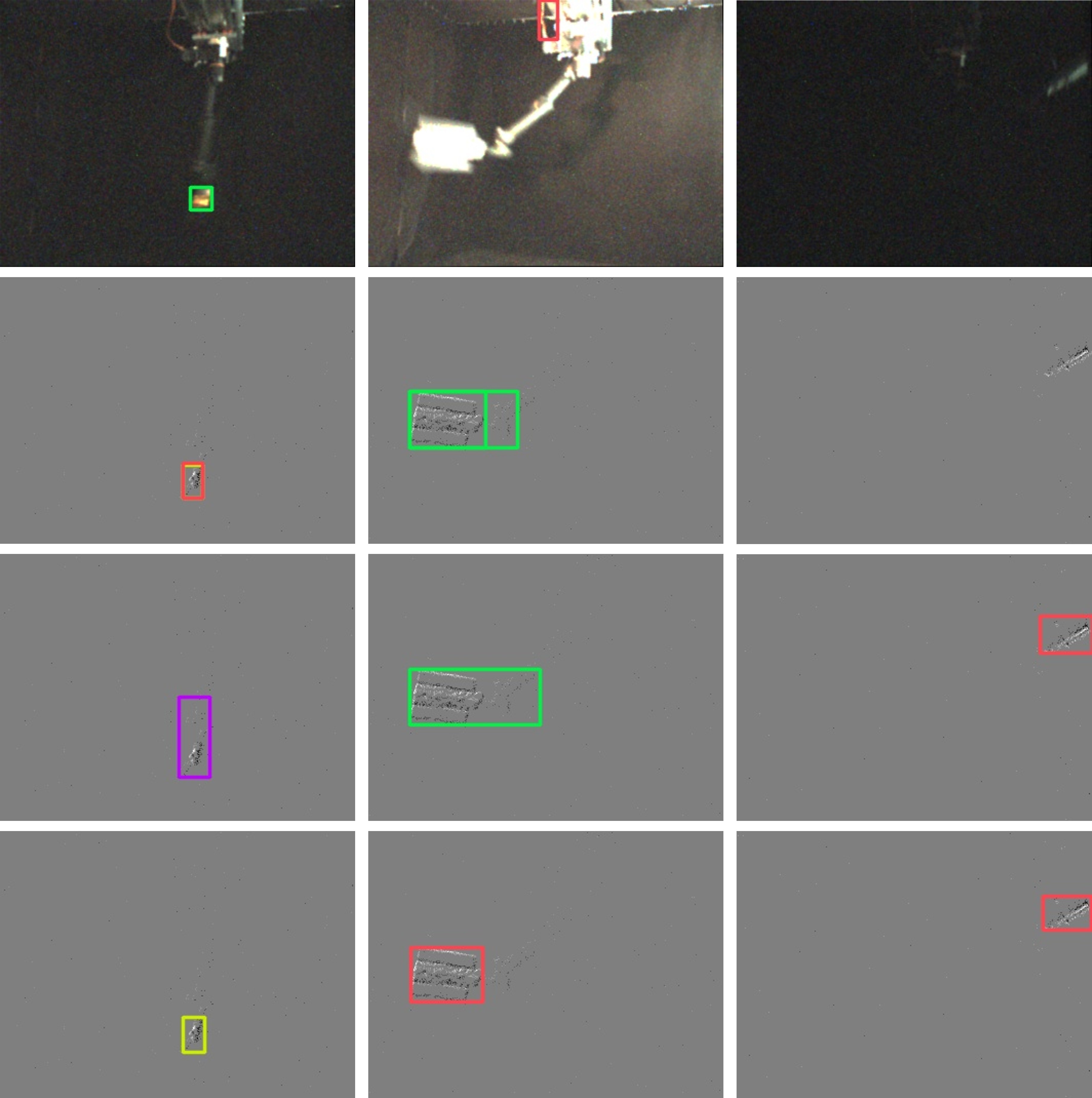
Due to motion blur, color degradation, and texture loss, RGB-based detectors struggle to localize targets under extreme illumination, especially failing completely under underexposure. In contrast, both YOLOv8s and M²Former exhibit stronger robustness when using event data,
which is less affected by illumination artifacts. Notably, although M²Former generates more detection boxes than YOLOv8s, these boxes remain consistently close to the target, indicating higher recall and better localization. This highlights a key trade-off: M²Former maintains
superior robustness and recall under challenging conditions, whereas YOLOv8s sacrifices recall to preserve precision—often leading to missed detections.
In summary, these results underscore the robustness of event data under extreme lighting conditions and demonstrate the strong sim-to-real generalization capability of the M²Former model, making it reliable for object detection in real-world space scenarios.
@ARTICLE{11263950,
  author={Pan, Ruitao and Wang, Chenxi and Han, Bin and Zhang, Xinyu and Zhai, Zhi and Liu, Jinxin and Liu, Naijin and Chen, Xuefeng},
  journal={IEEE Transactions on Geoscience and Remote Sensing},
  title={M2Former: Enhancing Event-Based RT-DETR for Robust and Lightweight Space Object Detection},
  year={2025},
  volume={63},
  pages={1-16},
  keywords={Space vehicles;Cameras;YOLO;Event detection;Transformers;Data augmentation;Computer architecture;Computational modeling;Training;Lighting;Event-based vision;multiscale MetaFormer design;real-time detection Transformer (RT-DETR);space object detection},
  doi={10.1109/TGRS.2025.3636122}}